

EVKEEZA is the first and only ANGPTL3 inhibitor that lowers LDL-C independently of LDLR activity1
- Patient with HoFH
- with evkeeza
Patients with HoFH have increased LDL-C due to diminished or absent LDLR function
- ANGPTL3, an angiopoietin-like protein, plays a prominent role in the regulation of lipid metabolism by inhibiting lipoprotein lipase (LPL) and endothelial lipase (EL).1,2
- Some clearance is still possible through VLDL remnant receptors.1,2
- Diminished/absent LDLR function prevents the LDL clearance, thereby increasing LDL-C levels.1,2
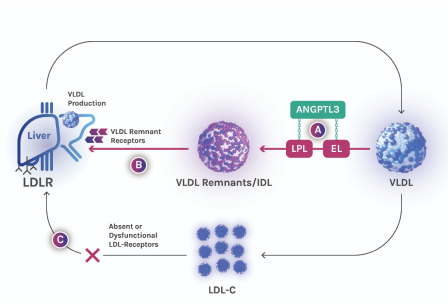
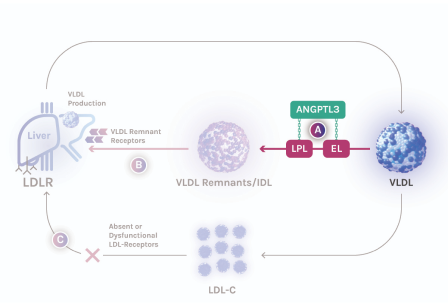
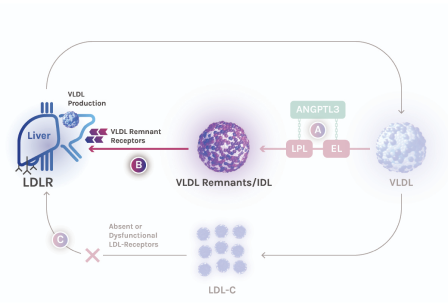
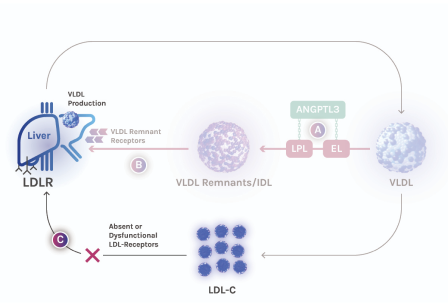
EVKEEZA binds to and blocks ANGPTL3, reducing LDL-C levels in an LDLR-independent manner1,3
- EVKEEZA binds to and blocks ANGPTL3.1,2,3
- By blocking ANGPTL3 with Evkeeza, the activity of LPL and EL results in clearance of VLDL remnants via remnant receptors in the liver.2,3
- By enhancing VLDL remnant clearance, EVKEEZA reduces LDL-C levels in an LDLR- independent manner.2,3
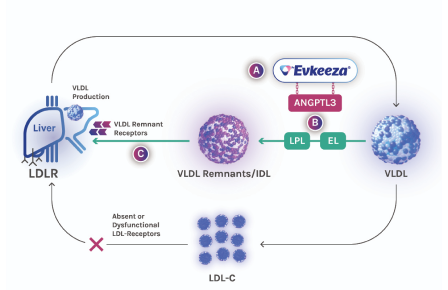
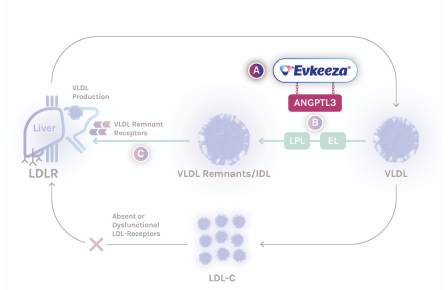
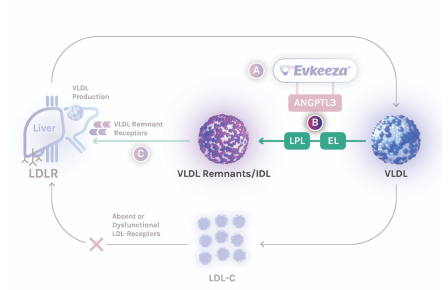
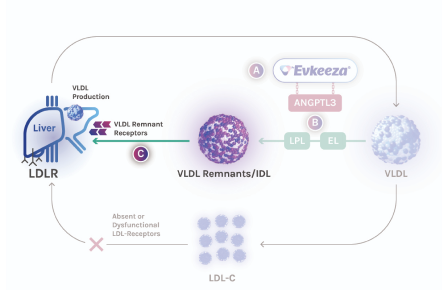
See how EVKEEZA inhibits ANGPTL3 to lower LDL-C
ANGPTL3=angiopoietin-like 3 protein; LDL-C=low-density lipoprotein cholesterol; LDLR=LDL-receptor; HoFH=homozygous familial hypercholesterolaemia; VLDL=very low-density lipoprotein; LPL=lipoprotein lipase; EL=endothelial lipase
References:
- EVKEEZA Product Monograph, Ultragenyx Pharmaceutical, Inc. 2025.
- Raal FJ, Rosenson RS, Reeskamp LF, et al. The long-term efficacy and safety of evinacumab in patients with homozygous familial hypercholesterolemia. JACC Adv. 2023;2(9):100648.
- Adam RC, Mintah IJ, Alexa-Braun CA, et al. Angiopoietin-like protein 3 governs LDL-cholesterol levels through endothelial lipase-dependent VLDL clearance. J Lipid Res. 2020;61(9):1271-1286.